
Bailee liability insurance covers customers’ property while it’s in your care, custody or control, either only when you’re found legally liable for the damage, or with a bailees’ customers form, regardless of fault. Most standard business insurance policies exclude this exposure entirely. If you repair, clean, store, transport or hold onto property that belongs to someone else, that gap is the one most likely to catch you out.
TL;DR:
- More businesses handling customer property should consider bailee liability insurance since standard policies often exclude care, custody, or control exposures.
- Coverage parameters include on-premises and in-transit property, with endorsements like mysterious disappearance and damage-in-process providing additional protection.
- Accurate limits, especially per-item caps, are crucial as underestimating the highest-value item handled can lead to inadequate payout during a claim.
- A policy must explicitly address transit exposure and endorsements like goodwill replacement to avoid common gaps in coverage.
- Improving physical security measures and detailed inventory procedures can significantly reduce premiums and enhance claim outcomes.
Table of Contents
- What is bailee liability insurance and how does the cover attach?
- Who actually needs bailee insurance?
- What does bailee cover typically pay for?
- Where policy wordings quietly let you down
- How insurers price bailee risk
- How to buy the right policy without overpaying
- What to do immediately after a loss
- InsureAble’s take for sole traders and support workers
- The one thing to check this week
- Get a bailee-aware policy built around how you actually work
- Sources
- FAQ
What is bailee liability insurance and how does the cover attach?
A bailment happens whenever one party (the bailor) hands property to another (the bailee) for a specific purpose, repair, cleaning, storage, transport, with an expectation it comes back intact. The bailee doesn’t own the item, but they’re responsible for it the moment they accept it, whether that’s a customer dropping off a suit at a dry cleaner or a courier loading a parcel onto a van.
Cover typically attaches from the moment property is received and runs until it’s returned, which means on-premises storage and in-transit movement both matter. The two main coverage forms behave differently. Legal-liability cover pays out only when the bailee is proven negligent, so a customer has to establish fault before receiving a cent. Bailees’ customers cover pays the customer directly regardless of who caused the loss, which is why it’s the more common choice for businesses that value fast, no-argument settlements. Standard property or public liability policies almost always carve out care, custody or control exposures, which is precisely the gap bailee coverage is designed to fill.
Who actually needs bailee insurance?
If your business ever takes possession of something you don’t own, you likely have this exposure whether you’ve thought about it or not. The businesses that turn up again and again in bailee claims share one trait: customers hand them physical items and expect them back in the same condition.
- Dry cleaners and laundries holding garments overnight or longer
- Repair workshops, mechanics and appliance technicians with customer property on the bench
- Jewellers accepting items for repair, cleaning or valuation
- Furniture and upholstery businesses collecting pieces for restoration
- Self-storage and warehouse operators holding goods long-term
- Couriers and removalists moving property between locations
- Valet and vehicle-minding services
Sole traders and NDIS support workers are an often-overlooked category. If you’re transporting a client’s mobility equipment, holding medication, or looking after personal belongings during a shift, that’s a bailment too, even though it doesn’t feel like “commercial” property handling. A quick self-check: do you ever take possession of something you don’t own? Would you be financially responsible if it were lost, stolen or damaged in your care? Does your current policy specifically mention care, custody or control? If you answered yes, no, and not sure, it’s worth reading your wording properly.
What does bailee cover typically pay for?
Cover generally responds to the perils you’d expect: fire, theft, flood, collision while in transit, explosion and vandalism. Bailee’s customers insurance extends to property both on your premises and while it’s moving between locations, which matters because a huge share of bailee losses happen mid-transit, not sitting on a shelf. A dry cleaner’s delivery van rolling in wet weather, or a repair technician’s vehicle broken into overnight, are textbook scenarios this cover is built for.
Several endorsements are worth knowing before you’re comparing quotes. Mysterious disappearance covers items that vanish without an obvious cause, useful when theft can’t be proven but the item is definitely gone. Damage-in-process protects against loss that occurs while you’re actively working on an item, a common gap in basic policies. Preservation coverage kicks in if you need to move property in an emergency, say, evacuating stock ahead of a flood, and it’s damaged during that relocation. Goodwill replacement lets you replace a customer’s item outright to protect the relationship, even when a formal claim wouldn’t otherwise require it. InsuredBetter’s summary of these add ons notes bailee cover is frequently bundled into a broader commercial package policy rather than sold as a standalone product.
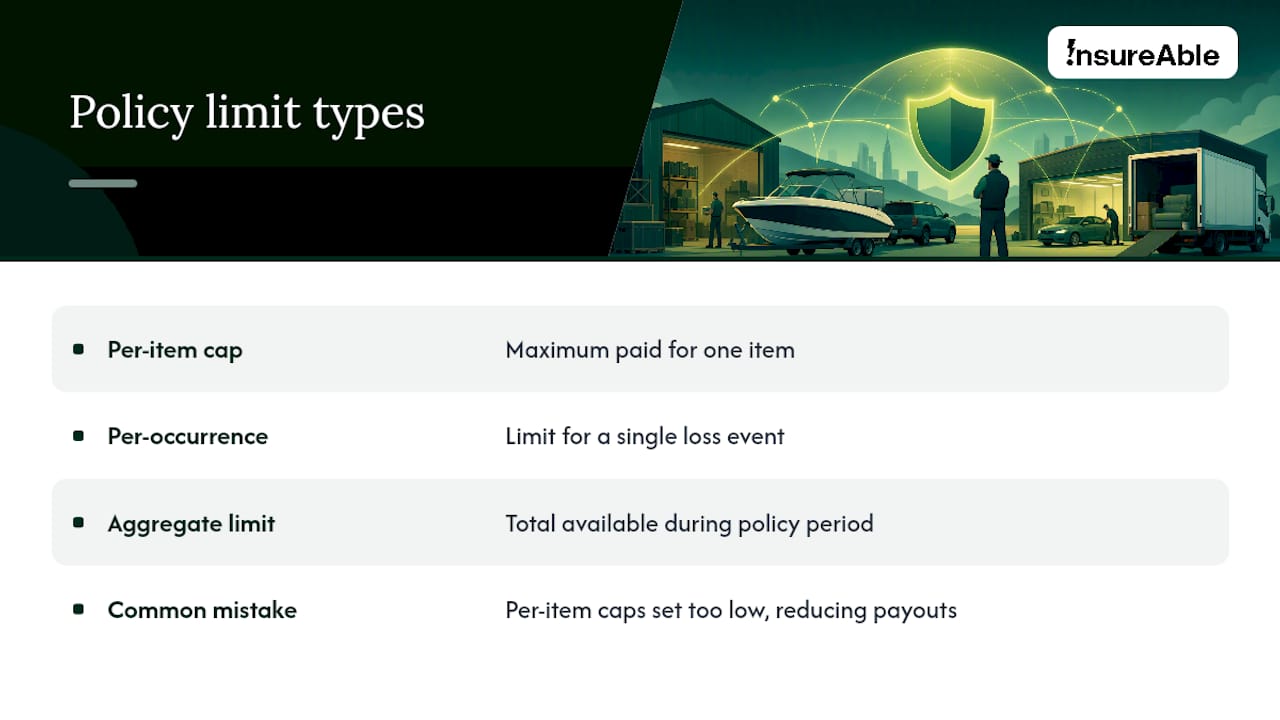
Limits are usually structured three ways: a per-item cap, a per-occurrence limit, and an overall aggregate limit for the policy period. Getting these numbers wrong, particularly per-item caps that don’t reflect what you actually handle, is one of the most common reasons a claim payout disappoints.
Where policy wordings quietly let you down
The exclusion that trips up more businesses than any other is the care, custody or control carve-out sitting inside a standard general liability or property policy. Businesses frequently assume their existing cover extends to customer property because it’s sitting in their premises, only to discover during a claim that it was never included.
Vermin and gradual deterioration exclusions are also standard, so a moth-damaged garment or a slowly rusting item usually won’t be covered no matter which form you hold. Valuation clauses matter just as much: some policies pay replacement cost, others pay an agreed value set at inception, and the gap between the two can be significant for higher-value items. A hold-harmless agreement or liability waiver signed by a customer offers weaker protection than most operators assume, and it won’t substitute for actual cover if a dispute ends up in front of a claims assessor or a court. When reading a wording, watch for narrow definitions of “property,” transit carve-outs that exclude the exact routes you use, and per-item caps buried in fine print well below what you typically hold.
How insurers price bailee risk
Underwriters work through a fairly consistent checklist: building construction, occupancy type, fire and security protection systems, the value and nature of goods typically held, prior loss history, and how tightly staff procedures control access to customer property. Pricing tends to follow these traditional exposure categories closely, which means two businesses holding identical stock can land on very different premiums based on how well they’re protected.
Practical improvements move the needle more than most operators expect. Installing monitored alarm systems, upgrading to fire suppression, and locking down after-hours access all signal lower risk to an underwriter. Physical protection upgrades are often the single most cost-effective lever available for managing premium over time, more so than shopping around every renewal. Clear receipting and inventory procedures matter just as much: a documented chain of custody, with photos and timestamps when an item arrives, gives both you and your insurer something solid to work from if a claim ever lands.

How to buy the right policy without overpaying
Getting an accurate quote comes down to asking the right questions and having your numbers ready before you call a broker.
- Ask whether transit exposure is included automatically or needs a separate extension.
- Confirm whether mysterious disappearance and damage-in-process are built in or optional.
- Check the per-item cap against the highest-value item you realistically handle.
- Clarify the aggregate limit against your typical stock or workload on any given day.
- Ask which endorsements, goodwill replacement or preservation coverage, suit your operation.
- Prepare loss history, an inventory approach, and typical item values before requesting terms.
Pro Tip: Don’t set your per-item limit based on an “average” job. Set it based on the single most expensive item you’ve handled in the past two years, because that’s the claim that will actually test your policy.
What to do immediately after a loss
Secure the property and the scene first, then notify your insurer as early as possible, delays can complicate a claim regardless of which form you hold. Preserve any paperwork: the original receipt given to the customer, photos taken on intake, and your inventory record showing condition on arrival. If the item belongs to a client rather than a walk-in customer, notify them promptly too, transparency here protects the relationship as much as the claim.
Insurers will typically ask for proof of value, whether that’s a receipt, valuation certificate, or comparable pricing, alongside your intake photos and any inventory log. Settlement then depends on the form you hold: a bailees’ customers policy generally pays out based on repair, replacement or agreed value without requiring proof of fault, while legal-liability cover requires the insurer to first establish negligence before any payment is assessed.
InsureAble’s take for sole traders and support workers
Some sole traders and support workers assume their public liability policy covers a client’s property because it’s sitting in their car or their home. It rarely does. Sector-aware wordings, combined with collective bargaining across a group of similar operators, can close that gap without pushing premiums out of reach for a single-person operation. Three habits protect you immediately: photograph and receipt every item you take responsibility for, keep a simple running inventory, and specifically ask for transit and goodwill endorsements rather than assuming they’re included.
The one thing to check this week
Pull out your current policy and search for the words “care, custody or control.” If you can’t find that phrase addressed clearly, assume you’re exposed. Anyone handling customer property regularly needs either dedicated bailee cover or a bailees’ customers form, not a policy that simply hasn’t been tested yet.
— Tommy
Get a bailee-aware policy built around how you actually work
A tailored alternative to a generic business policy exists for support workers and small operators who handle other people’s property, incorporating sector-informed wording developed by former support workers and priced to allow more affordability than a one-size-fits-all rate card. Where a standard package quietly excludes care, custody or control exposures, Certain public liability policies and related endorsements are shaped around the realities of transporting equipment, holding client belongings, and working across multiple locations in a single day.

Before you request a quote, have three things ready: your loss history (even if it’s simply “none”), a rough sense of how you track items in your care, and the typical value of what you handle. Head to Insureable’s main site to see how public liability and professional indemnity cover fit together, or go straight to the proposal form to start a tailored quote.
This article is general information, not a substitute for advice from a qualified financial advisor. Consult a qualified financial professional about your own circumstances before acting on anything here.
Sources
- Definition: Bailee liability insurance – Insurer Brain
- bailee coverage — IRMI
- Bailee’s customers insurance — Investopedia
- Bailee’s customer insurance: What it is & how it works — InsuredBetter
FAQ
What are the liabilities of a bailee in a bailment?
A bailee is responsible for taking reasonable care of property entrusted to them and returning it in the condition it was received, and can be held liable for loss or damage caused by negligence. The exact standard of care depends on the type of bailment and the terms agreed, which is why legal commentary on bailment duties treats fault and standard of care as central questions in any dispute.
What is trailer bailee coverage?
Trailer bailee coverage is a specific application of bailee insurance for businesses that tow, store or transport trailers belonging to someone else, covering damage or loss while the trailer is in their custody. It works the same way as general bailee cover, either paying based on proven fault or, under a bailees’ customers form, regardless of fault, and transit exposure is usually the main risk it’s built to address.
Do I need bailee insurance if I already have public liability?
Public liability typically covers third-party injury or property damage you cause, but it generally excludes property that’s in your care, custody or control. If your work involves holding, repairing or transporting someone else’s belongings, you likely need dedicated bailee cover alongside your public liability policy.
What’s the difference between legal liability and bailees’ customers cover?
Legal-liability cover only pays out once negligence has been proven against you, while a bailees’ customers form pays the customer directly regardless of fault. Many small operators prefer the customers form because it settles disputes faster and protects the relationship even when fault is unclear.
How much does bailee insurance cost?
Premiums depend on underwriting factors like security, fire protection, loss history and the value of goods typically handled, so there’s no fixed rate across the industry. Insureable prices bailee-related endorsements individually based on your operation, and current terms are available by requesting a quote through the proposal form.