
A certificate of currency is a short document from your insurer or broker confirming that a named policy is active on the date its issued. It’s the standard proof landlords, lenders, head contractors, clients and NDIS auditors ask for before they’ll sign a contract or approve registration. Treat it as a snapshot, though. It doesn’t replace your full policy wording, and it doesn’t create any new rights for whoever’s holding it.
TL;DR:
- Most certificates of currency confirm that an active insurance policy is in place but do not provide details on policy exclusions, endorsements, or specific clauses.
- Verification requires contacting insurers directly to ensure the certificate’s details, such as policy number, limits, and expiry date, are accurate and current.
- Certificates must match the contractual or registration demands; lower cover limits or missing endorsements can invalidate the document for specific requirements.
- Obtaining a certificate is usually quick through insurer portals or brokers, but explicit requests for endorsements or additional insured status may cause delays.
- For disability support providers, tailored policies aligned with NDIS requirements help generate compliant certificates and prevent the need for costly patching later.
Table of Contents
- What information appears on a certificate of currency?
- Who actually needs one, and when does it get requested?
- How do you get a certificate of currency?
- How do you verify a certificate and avoid cancellation risk?
- What a certificate of currency doesn’t do
- Why compliant certificates are harder for disability support providers than they should be
- Get cover that produces the right certificate the first time
- Where to check the details yourself
- Sources
- FAQ
What information appears on a certificate of currency?
A properly issued certificate follows a fairly predictable format, which makes it easy to check whether the one you’re holding actually has what it needs. The Tasmanian Consumer, Building and Occupational Services guidance confirms the standard fields, and most Australian insurers follow the same layout regardless of policy type.
Expect to see:
- Insured name and, where relevant, ABN
- Policy number and period of insurance (start and expiry dates)
- Type of cover (public liability, professional indemnity, workers’ compensation, and so on)
- Limits or sums insured
- Interested parties or certificate holders named on the document
Policy type changes what shows up. A workers’ compensation certificate lists wages and number of workers covered, while a liability certificate focuses on limits and cover types. None of these documents reproduce full policy wording, endorsements or exclusions. Those details sit in the Product Disclosure Statement (PDS) and policy schedule, and that’s where you go if a contract requires proof of a specific clause.
Who actually needs one, and when does it get requested?
Certificates of currency get requested constantly across Australian business, often at the exact moment you’re least prepared for the paperwork. Commercial leases, construction sites, subcontractor agreements, lender conditions and event permits routinely make a certificate mandatory before anyone signs off. Construction contracts frequently specify minimum insurance limits that your certificate needs to match line for line.
For NDIS providers, the requirement is baked into registration itself. The NDIS verification module lists certificates of currency as required documentation for public liability, professional indemnity and accident or worker cover, and the NDIS Practice Standards expect appropriate insurance to be in place before you’re approved to deliver services.
Common triggers to watch for:
- Signing or renewing a commercial lease
- Starting work on a construction site or as a subcontractor
- Applying for or renewing NDIS registration or verification
- Taking out a loan where the lender wants proof of cover
- Running or supplying an event that requires public liability evidence
Match the certificate’s limits and endorsements to what the contract actually asks for. A certificate showing a lower public liability limit is worthless if the head contract demands a higher amount.
How do you get a certificate of currency?
Getting a certificate is usually faster than people expect, provided you know which door to knock on first.
- Try self-service first. Most Australian insurers and workers’ compensation schemes let you log in and download a PDF instantly. icare NSW’s employer portal is a good example, showing business name, ABN, wages and worker numbers on demand, and renewal packs are typically sent around six weeks ahead of expiry.
- Go through your broker if you use one. Specify exactly who the certificate is for, what limits they need to see, and whether they require specific endorsement wording.
- Give your broker or insurer the full brief upfront. Policy number, ABN, recipient name and address, required limits, and any endorsement text the requesting party has demanded. Vague requests come back with the wrong details, and you’ll be doing this twice.
Timing varies. Portal downloads are near instant. Broker requests can take a day or two, particularly if an endorsement needs underwriter sign off. Certificates can go straight to the third party or arrive as an emailed PDF for you to forward.
Pro Tip: If a contract requires you to be named as an “additional insured” rather than just a certificate holder, say so explicitly when you request the document. That status requires a formal endorsement on the policy, not just a mention on the certificate, and asking late can cost you days.
How do you verify a certificate and avoid cancellation risk?
Don’t take a certificate at face value just because it looks official. Contact the insurer or broker using contact details you’ve sourced independently, not the number printed on the document itself, and confirm the policy number, cover types and limits match what’s been supplied to you.
Every standard certificate carries an ACORD-style disclaimer stating it’s informational only and doesn’t amend or extend the policy in any way. LegalClarity’s explainer makes the point clearly: being named on a certificate doesn’t give you any right to claim under someone else’s policy. If you need that right, you need a formal endorsement.
There’s a sharper risk too: a certificate can become invalid before its printed expiry date if the underlying policy is cancelled mid-term. Request a written notice of cancellation endorsement where the relationship warrants it, particularly for lease guarantors or lenders.
Before accepting any certificate, confirm:
- The insurer name and the policy number match your records
- The expiry date is genuinely in the future
- Any required endorsement is actually attached, not just promised
- You have a direct contact at the insurer or broker for follow up
What a certificate of currency doesn’t do
A certificate is a summary, not a contract. It doesn’t change the terms of the underlying policy, and it doesn’t hand the certificate holder any right to make a claim. That’s the core distinction between a certificate holder and an additional insured. A certificate holder is simply named as having sighted evidence of cover. An additional insured has actually been added to the policy through a formal endorsement, which is a different process entirely and usually needs the insurer’s sign off.
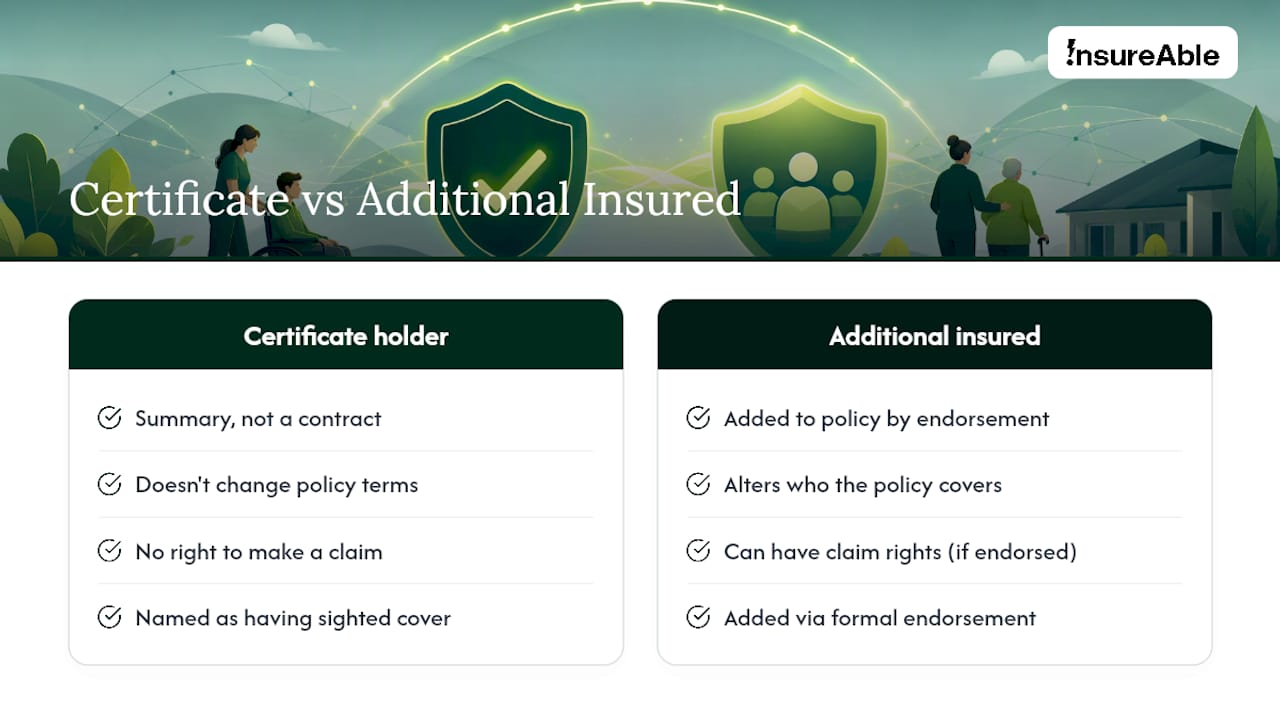
If a tender, licence or contract demands specific protections, a certificate won’t get you there. Ask for the PDS, the full policy schedule, or the exact endorsement wording the other party needs, and get it in writing before you rely on it.
Why compliant certificates are harder for disability support providers than they should be
Generic insurance policies rarely map cleanly onto disability support work, and that gap shows up right when a provider needs a certificate fastest, usually mid-registration or mid-audit. We built Insureable because former support workers kept hitting the same wall: policies written for other industries, with cover categories that don’t match what NDIS auditors actually ask for.
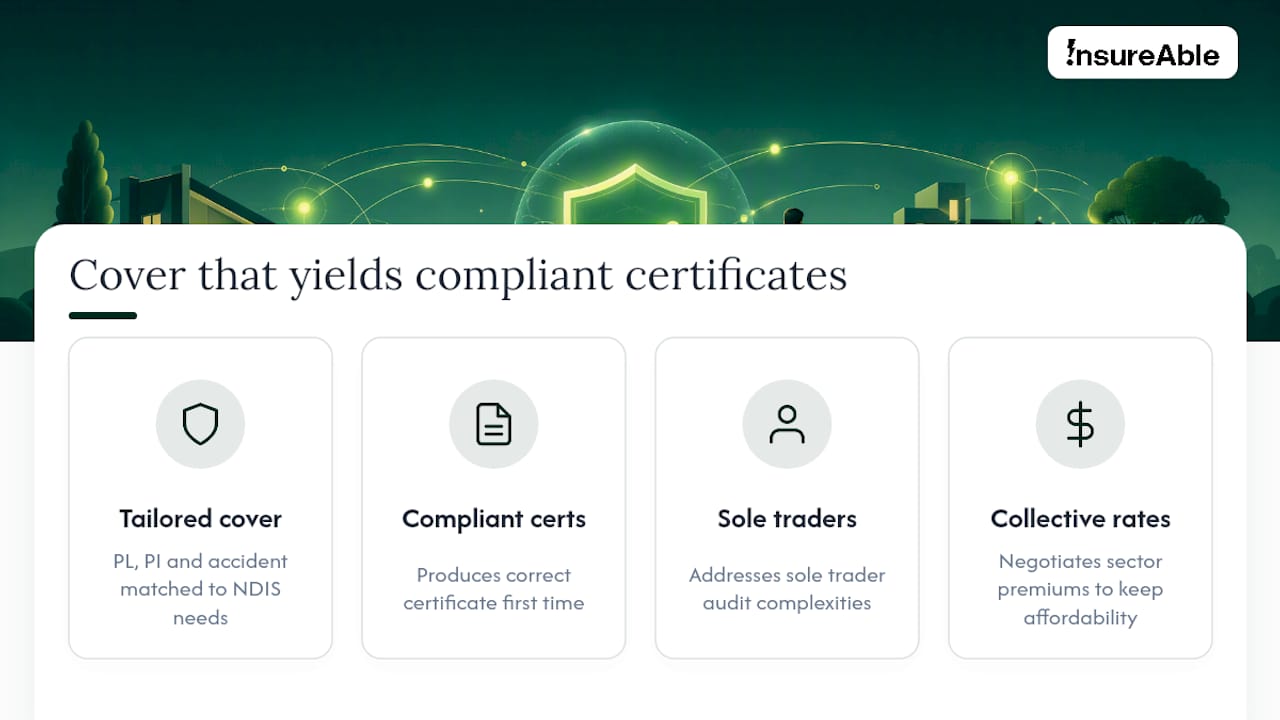
Tailored policies built around public liability, professional indemnity and individual accident cover reduce the back-and-forth when a certificate needs to show the right limits and endorsements the first time. Getting the underlying policy right from the start means the certificate that comes out the other end actually matches what registration or a client contract demands.
— Tommy
Get cover that produces the right certificate the first time
Insureable is built for disability support work specifically, so the public liability, professional indemnity and individual accident cover you hold actually matches what NDIS registration and client contracts ask for, no scrambling to patch gaps when a certificate request lands on your desk.

Whether you’re a sole trader juggling multiple clients or running a larger care organisation, the policy structure matters as much as the price. Sole trader support workers face particular complexities worth understanding before you’re mid-audit, and if you’re unsure whether your current cover stacks up, it’s worth checking whether most NDIS providers are underinsured against the five questions that actually matter. Insureable also negotiates collective premiums across the sector, so affordability doesn’t mean settling for generic gaps in cover.
Ready to sort out a policy that produces compliant certificates without the runaround? Start a proposal and get tailored public liability, professional indemnity and accident cover set up properly from day one.
Where to check the details yourself
For direct verification, consult Consumer, Building and Occupational Services Tasmania for certificate basics, the NDIS Commission’s verification requirements for registration documentation, icare NSW for workers’ comp downloads, and MoneySmart for general consumer guidance.
Sources
- What is a Certificate of Currency? — Consumer, Building and Occupational Services (Tasmania)
- NDIS verification module — required documentation (NDIS Commission)
- Download a Certificate of Currency — icare NSW
- What is a certificate of currency for insurance? — LegalClarity
FAQ
How do I get an insurance certificate of currency?
Log into your insurer’s or broker’s self-service portal first, since most Australian insurers offer instant PDF downloads. If you don’t have portal access, contact your broker directly and specify the recipient’s details, required limits and any endorsement wording needed.
How do I get a certificate of currency in Australia?
The process is the same nationally: request it from your insurer or broker, supplying your policy number, ABN and the exact requirements of whoever’s asking. Workers’ compensation certificates come through state schemes like icare NSW, which allow employers to download one on demand.
Is a certificate of currency the same as an insurance policy?
No. A certificate is a summary snapshot confirming a policy is active, while the full policy and its PDS contain the actual terms, exclusions and conditions. The certificate doesn’t amend or replace anything in the underlying policy.
Do I need a certificate of currency for home insurance?
Lenders and mortgagees commonly request one to confirm your home is insured before settlement or throughout a loan term. If your insurer holds your home and contents policy, you can request a certificate showing the lender as an interested party.
Is a certificate of currency required for NDIS registration?
Yes. The NDIS verification module lists certificates showing public liability, professional indemnity and accident or worker cover as required documentation for both new registration and ongoing verification checks.